
How Long Does Gas Last in a Generator?
How to store generator fuel, when to use a stabilizer and how to keep a generator ready for an outage.
 By Home Power Up Team
Updated November 19, 2026

Gasoline does not last forever. Left in a tank or can for months, it can go stale, and old fuel is a common reason a generator will not start when you need it. This guide explains how to store generator fuel, when a stabilizer helps and how to keep your generator ready for an outage.
Why Stored Gas Goes Bad
Gasoline slowly oxidizes, and fuel that contains ethanol can also pull moisture from the air. Over time, fuel can form gum and varnish that clog small carburetor passages. How fast that happens depends on the fuel, the container and the temperature. The fuel stabilizer listings below state storage of up to 24 months, but those are seller claims, so follow your generator manual.
How to Store Fuel
- Use approved cans with tight lids. See our 5-gallon gas can guide.
- Store them outdoors in a detached shed or well-ventilated space, away from the house, the generator and ignition sources.
- Label cans with the fill date and use the oldest first.
- Keep cans out of direct sun and off heat.
- Follow local limits on how much fuel you may store.
When to Add a Stabilizer
Add a stabilizer when fuel will sit for weeks or months, such as an emergency can or a generator stored over winter. Add it before the fuel goes in the tank, mix it as the label says, then run the engine for a few minutes so treated fuel reaches the carburetor.
| Product | Listing claims | Stated dose |
|---|---|---|
| STA-BIL Storage 32 oz | Keeps fuel fresh up to 24 months; treats 80 gallons | 1 oz per 2.5 gallons; run engine 5 minutes |
| Star Tron Enzyme Fuel Treatment | Stabilizes fuel for up to 2 years; helps prevent ethanol problems | 1 oz per 6 gallons |
| Ethanol Shield 24 oz (2-pack) | Antioxidant and anticorrosive; phase separation inhibitor | See the label |
| Award | Product | Price | |
|---|---|---|---|
| Best Budget |
STA-BIL Storage Fuel Stabilizer, 32 oz
|
$13.98 | Buy |
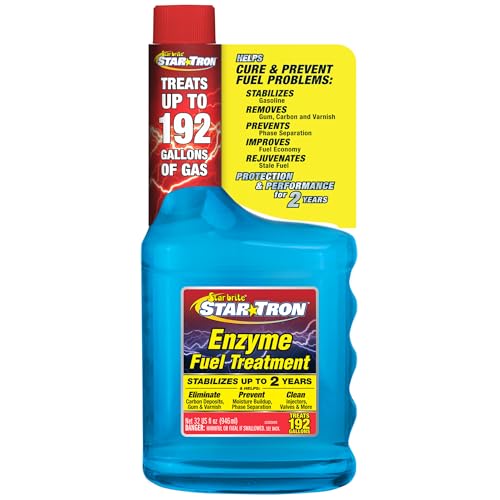 Star TRON Enzyme Fuel Treatment - Gas |
$22.28 | Buy | |
| Best Overall |
 Ethanol Shield Fuel Stabilizer, 24 oz (2 Pack) |
$38.70 | Buy |
Details come from the listings for the STA-BIL Storage stabilizer, the Star Tron treatment and Ethanol Shield. Dose rates differ by product, so read the bottle.
Before an Outage Season
- Check your generator manual for fuel and storage guidance.
- Run the generator on a schedule the maker suggests, outdoors and away from the house.
- Rotate stored fuel into your car, if the manual allows, and refill with fresh fuel.
- Keep a CO alarm in the home. See our CO alarm guide.
- Consider a dual fuel unit if you also use propane. See dual fuel generators.
Refueling Safety
Shut the generator off and let it cool before you add fuel. Pour slowly, wipe up spills and keep the fuel away from sparks. Never run a generator in a garage, basement, crawlspace or enclosed space, even with doors open. Exhaust contains deadly carbon monoxide. Keep it outdoors and well away from windows, doors and vents.
Frequently Asked Questions
How long does gas last in a generator?
It varies with fuel, container and temperature. Treated fuel can last longer, but follow your manual.
Do I need a stabilizer if I use fuel quickly?
Usually not. It matters for long storage.
Can I use stale gas?
Old fuel can cause starting trouble. Follow your manual and local disposal rules.
Should I drain the tank?
Follow your generator manual. It may suggest running the fuel out or using the fuel shutoff.
Where do I store the fuel?
Outdoors in a detached shed or well-ventilated space, away from ignition sources.
Final Verdict
Store fuel in approved cans, outdoors and away from ignition sources, label it, rotate it and use a stabilizer if it will sit. Browse our generator accessories.
About the author

The Home Power Up team researches and writes buying guides on portable power stations, solar, generators and home backup power. We compare manufacturer specifications, listing details and published ratings to help US homeowners choose gear. We do not test products ourselves, and we explain our method in How We Review.