
Jackery HomePower 1000 Plus v2 Review: Expandable 1,024Wh
Jackery HomePower 1000 Plus v2 review based on the listing: 1,024Wh expandable to 11kWh, priority circuit, specs, runtime estimates, pros and cons.
 By Home Power Up Team
Updated November 11, 2026

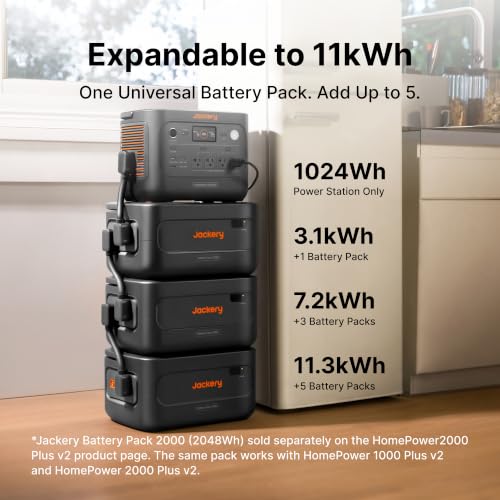
The Jackery HomePower 1000 Plus v2 is a 1,024Wh LiFePO4 power station that can expand to 11kWh and splits its outlets into a priority circuit. This review uses the manufacturer’s listing and product details to explain what it offers, who it suits, and where it falls short. We have not measured this unit ourselves. It is our top pick for keeping a refrigerator running in our refrigerator guide.
Expansion and load management are what set this unit apart from other 1kWh models. If you are weighing whether to plan for growth, read our expandable guide alongside the numbers below.
Quick Verdict
The HomePower 1000 Plus v2 is a good fit for households that want a light 1kWh starter that can grow and keep essentials running first. The trade-offs are the cost and weight of extra battery packs, a cycle claim measured to 70 percent, and 1,800W output that is lower than some rivals.
Jackery HomePower 1000 Plus v2 Portable Power




As an Amazon Associate we earn from qualifying purchases. Product prices and availability are accurate as of the date/time indicated.
Key Specifications
| Spec | Listing details |
|---|---|
| Capacity | 1,024Wh LiFePO4; expandable to 11kWh with up to five battery packs sold separately |
| Output | 1,800W AC, 3,600W surge, 140W USB-C |
| Outlets | Four AC outlets on two independently controlled circuits |
| UPS switchover | Under 10ms, stated by the manufacturer |
| Surge protection | 3kV / 1000J built in, per the listing |
| Recharging | About 1.25 hours from a wall outlet; 50 minutes in an app emergency mode, per the listing |
| Battery life | 6,000 cycles to 70 percent capacity, including in temperatures as low as 14°F, per the listing |
| Size and weight | 23.8 lb; 12.3 x 7.9 x 9.3 inches |
Battery packs are sold separately, and the listing says the CTB 2.0 design makes it 18 percent smaller than the Explorer 1000 v2. Confirm which packs are compatible with this exact model.
What It Does Well
Priority circuit load management
The four AC outlets are split across two circuits. You can assign critical devices to one and set a battery cut-off for the other, so the non-priority circuit switches off automatically and the essentials run longer. For a refrigerator, that is a practical feature.
Expansion path
Jackery lists up to five battery packs for 11kWh in total. That lets you start at 1kWh and add capacity as your needs grow. Packs add cost and weight, so price the whole system first.
Light for the class
At 23.8 lb it is one of the lighter 1kWh units we reviewed, and the listing describes a long cycle claim and cold-temperature rating. These are manufacturer figures.
How Long Will It Run Your Devices?
The battery holds 1,024Wh, and about 85 percent of that, roughly 870Wh, is a reasonable planning figure for usable energy. These are estimates calculated from that figure, not measurements of this unit.
| Device (example) | Watts | Estimated runtime |
|---|---|---|
| Wi-Fi router | 15 | about 58 hours |
| Laptop charging | 60 | about 14.5 hours |
| Television | 100 | about 8.7 hours |
| Small fridge, while running | 120 | about 7.3 hours |
| Coffee maker | 1000 | about 52 minutes |
The 1,800W rating covers many loads, but high-draw items drain the battery quickly. For a refrigerator, use its daily energy rather than rated watts, as in our fridge guide.
Things to Consider
- Battery packs are sold separately and add cost and weight.
- The 6,000-cycle figure is measured to 70 percent capacity.
- 1,800W is lower than the DJI or OUPES rivals in our roundup.
- Specifications come from the listing, so confirm details on the product page before buying.
Who Should Buy It
It suits households planning a staged backup system, owners who want a priority circuit for a fridge or router, and buyers who value a lighter body.
Who Should Skip It
Skip it if you never plan to expand and want the highest possible output, or if you need 2,000W or more. See the 1000Wh roundup for alternatives.
How It Compares
Against the OUPES Mega 1, the HomePower lists a longer expansion path and a lower weight, while the OUPES lists higher surge. Against the EcoFlow DELTA 3, it is lighter with a longer cycle claim. See our refrigerator guide for how they compare for a fridge.
Setup and Everyday Use
Charge it before first use, set up the Jackery app over Wi-Fi or Bluetooth, and assign your priority devices to the right circuit. Keep the vents clear and follow the manual for connecting extra packs.
Accessories to Consider
- Jackery-compatible battery packs, if you plan to expand. Check model compatibility.
- Solar panels for recharging. See portable solar panels.
- A carrying case with ventilation. See carrying cases.
Browse power station accessories for related gear, and read what size power station you need to confirm the capacity fits your plan.
Frequently Asked Questions
Can it run a refrigerator?
Often for part of a day, depending on the fridge, and the priority circuit helps. See our fridge guide.
How many battery packs can it use?
The listing says up to five, for 11kWh. Packs are sold separately.
Does it have a UPS function?
Yes, the listing states under 10ms.
Is it good for a power outage?
For essentials, yes. See power stations for outages.
Does it work in the cold?
The listing states 6,000 cycles even in temperatures as low as 14°F. Check the manual for charging limits.
Final Verdict
The HomePower 1000 Plus v2 earns its place for light weight, a priority circuit and a long expansion path. Its limits are lower output than some rivals and the cost of packs. Check the Jackery HomePower 1000 Plus v2 listing for the latest details and compare it with other options in our mid-size power stations category.
About the author

The Home Power Up team researches and writes buying guides on portable power stations, solar, generators and home backup power. We compare manufacturer specifications, listing details and published ratings to help US homeowners choose gear. We do not test products ourselves, and we explain our method in How We Review.