
BLUETTI Elite 200 V2 Review: 2,080Wh With 2,600W Output
BLUETTI Elite 200 V2 review based on the listing: 2,080Wh LFP, 2,600W output, low standby draw, specs, runtime estimates, pros and cons.
 By Home Power Up Team
Updated November 11, 2026

The BLUETTI Elite 200 V2 is a 2,080Wh LFP power station with 2,600W output and a very low listed standby draw. This review uses the manufacturer’s listing and product details to explain what it offers, who it suits, and where it falls short. We have not measured this unit ourselves. It is our top pick in our 2000Wh roundup.
At around 2kWh, the details that matter are output, standby draw and how fast you can refill the battery. If you are still deciding on size, read how long a 2000Wh power station lasts first.
Quick Verdict
The Elite 200 V2 is a good fit for people who want a 2kWh unit that wastes little energy while idle and offers several charging modes. The trade-offs are weight, 44.5 lb, and an expansion option that the listing excerpt does not describe.
BLUETTI Elite 200 V2 Portable Power Station 2080Wh


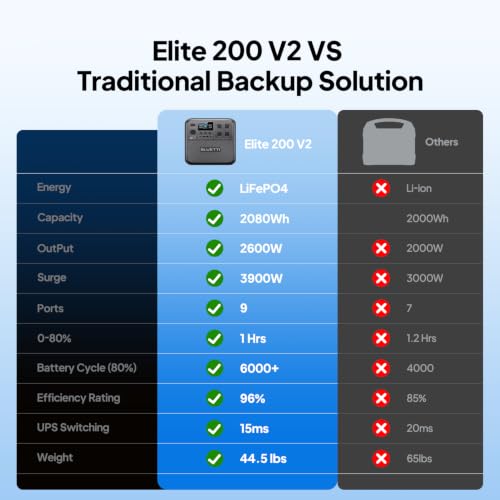


As an Amazon Associate we earn from qualifying purchases. Product prices and availability are accurate as of the date/time indicated.
Key Specifications
| Spec | Listing details |
|---|---|
| Capacity | 2,080Wh LFP |
| Output | 2,600W continuous; 3,900W in Power Lifting mode; four AC outlets; up to 9 devices at once |
| Standby draw | About 10W, which BLUETTI says is three times lower than similar units |
| Battery life | 6,000+ cycles and a 17-year life claimed |
| Charging modes | Turbo (0 to 80 percent in about 1 hour at 1,800W AC), Standard (1,440W AC, full in 1.6 hours), Silent (800W AC or solar, full in 3 hours, 16 to 30 dB) |
| Fast charging | 0 to 80 percent in about 50 minutes with combined AC and DC, per the listing |
| Size and weight | 44.5 lb; 13.78 x 9.84 x 12.74 inches |
Power Lifting is for specific loads, usually resistive ones. The 17-year life and cycle claims are the manufacturer’s figures.
What It Does Well
Low standby draw
The listing says idle consumption is about 10W. A unit that sits switched on for days loses less energy, which helps in a multi-day outage. For example, 10W for 24 hours is about 240Wh.
Three charging modes
Choose Turbo for speed, Standard for battery-friendly charging or Silent for quiet. BLUETTI lists the Silent mode at 16 to 30 dB, which suits nights indoors.
High output for its size
2,600W continuous covers many kitchen appliances for short periods and workshop tools. A 2,600W load still empties the battery in under an hour.
How Long Will It Run Your Devices?
The battery holds 2,080Wh, and about 85 percent of that, roughly 1,768Wh, is a reasonable planning figure for usable energy. These are estimates calculated from that figure, not measurements of this unit.
| Device (example) | Watts | Estimated runtime |
|---|---|---|
| Wi-Fi router | 15 | about 118 hours |
| Refrigerator, daily average | 60 | about 29 hours |
| Laptop charging | 60 | about 29 hours |
| Television | 100 | about 17.7 hours |
| Microwave | 1000 | about 106 minutes |
The 60W refrigerator average is an illustrative example. Use your own fridge’s daily energy from the label. Standby draw is extra when AC output is on.
Things to Consider
- Weight: 44.5 lb is heavy for one person to carry far.
- The listing excerpt does not describe expansion batteries.
- Power Lifting applies only to certain loads.
- The 17-year life and 6,000-cycle claims are maker figures.
- Specifications come from the listing, so confirm details on the product page before buying.
Who Should Buy It
It suits homeowners who want a 2kWh backup for a fridge, router and electronics, and anyone who values low idle consumption and charging flexibility.
Who Should Skip It
Skip it if you want expansion in the same family, where the expandable units are a better fit, or if you need the lightest 2kWh unit.
How It Compares
Against the Anker SOLIX C2000 Gen 2, the Elite 200 V2 lists a longer cycle claim and a Power Lifting mode, while the Anker lists more ways to recharge and expansion to 4kWh. Against the Jackery Explorer 2000 v2, it is about 5 lb heavier with higher output. See our 2000Wh roundup.
Setup and Everyday Use
Charge it before first use, choose a charging mode in the app, and keep the vents clear. Switch off AC output when not in use to avoid the standby draw.
Accessories to Consider
- Solar panels. See portable solar panels.
- Rated cords. See heavy-duty extension cords.
- A carrying case if you move it often. See carrying cases.
Browse power station accessories for related gear, and read what size power station you need to confirm the capacity fits your plan.
Frequently Asked Questions
Can it run a refrigerator?
Often for a day or more, depending on the fridge. See our fridge guide.
How fast does it charge?
The listing states 0 to 80 percent in about an hour in Turbo mode, and a full charge in about 1.6 hours in Standard mode.
Is it quiet?
The listing gives 16 to 30 dB in Silent mode. Louder modes are faster.
Is it good for a power outage?
For a fridge and electronics, yes. See power stations for outages.
Can it run a window air conditioner?
Small ones briefly. See our guide.
Final Verdict
The Elite 200 V2 stands out for low standby draw, high output and flexible charging at about 2kWh. Its limits are weight and the unlisted expansion. Check the BLUETTI Elite 200 V2 listing for the latest details and compare it with other options in our large power stations category.
About the author

The Home Power Up team researches and writes buying guides on portable power stations, solar, generators and home backup power. We compare manufacturer specifications, listing details and published ratings to help US homeowners choose gear. We do not test products ourselves, and we explain our method in How We Review.