
5 Best 400W Portable Solar Panels of 2026
Compare 5 portable 400W-class solar panels on weight, voltage and compatibility for large power stations.
 By Home Power Up Team
Updated November 20, 2026
A 400W panel suits large power stations, but 400W panels also carry the highest risk of a mismatch, because many use 40V or higher open-circuit voltage that smaller stations cannot accept. This guide compares five 400W-class portable panels from their listings.
Check your power station’s maximum solar input watts, voltage window and connector type in its manual before you buy any panel. Panels at this size are for stations of about 2000Wh and up. For smaller stations, see 200W panels. Large stations are covered in our large power station guides.
All Products Compared
| Product | Rated Power | Weight | Form | Voltage Notes |
|---|---|---|---|---|
| Renogy 400W Blanket | 400W | 16.09 lb | 16-fold blanket, 16.54 x 15.83 x 4.13 in | MC4 only, adapter sold separately |
| ZOUPW 450W | 450W | 29.5 lb | Fiberglass, 4 kickstands | Voc 45.9V, not for under 30V inputs |
| NaveiTech 400W | 400W | 19.84 lb | Folds to about 21 x 26 in | Parallel wiring, input limit note |
| CTOLITY 400W | 400W | Not in the excerpt | Foldable, kickstands | 40V MC4, XT60, Anderson |
| ALLPOWERS SP037 | 400W | 40.8 lb | 5 foldable panels | Polycrystalline 22% per listing |
| Award | Product | Price | |
|---|---|---|---|
|
Renogy 400W Portable Solar Panel for Power
|
$422.99 | Buy | |
| Best Premium |
 ZOUPW 450W Portable Solar Panel N-Type 16BB |
$499.99 | Buy |
| Best Budget |
 NaveiTech 400W Portable Solar Panel |
$275.89 | Buy |
| Best Value |
 CTOLITY 400W Portable Solar Panel for Power |
$299.99 | Buy |
| Best Overall |
 ALLPOWERS SP037 400W Portable Solar Panel |
$299.00 | Buy |
Top 3 Panels Reviewed
#1 Renogy 400W Portable Solar Panel Blanket: Lightest 400W Option Here
Why We Picked It
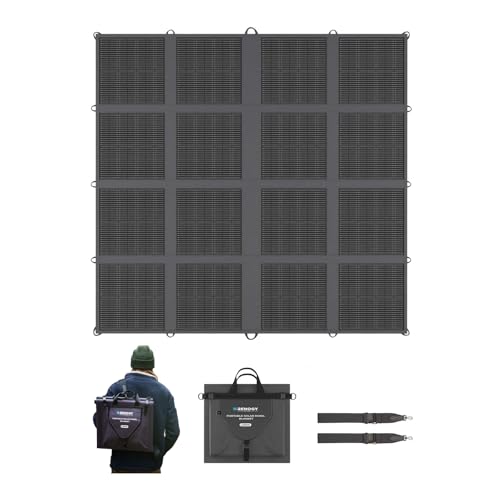
The Renogy 400W is a 16-fold blanket that lists 16.09 lb and folds to 16.54 x 15.83 x 4.13 in. It claims 25% N-type efficiency and says the blanket can lie on the ground, hang between trees or racks, or go across a windshield.
The listing names Jackery Explorer 1000 v2, EcoFlow DELTA 3 and DELTA 3 Max, and Anker SOLIX S2000, C1000 Gen 2 and C2000 Gen 2 as compatible, with MC4 output only and a separately sold adapter. It says UL 61730 certified and that real output varies with sun angle, temperature, shade, cable length and input limits.
Key Specifications
- Rated power: 400W
- Weight: 16.09 lb
- Folded size: 16.54 x 15.83 x 4.13 in
- Cell: N-type, 25% claimed
- Output: MC4 only
| Pros | Cons |
|---|---|
|
|
Things to Consider
Secure a blanket with stakes or weights in wind, and keep it flat toward the sun.
Best For
Owners of large stations who need to move the panel often.
Skip It If
Skip it if you want a kickstand panel.
See the Renogy 400W Portable Solar Panel Blanket listing for current details.
#2 ZOUPW 450W Portable Solar Panel: Best for High-Voltage Large Stations
Why We Picked It
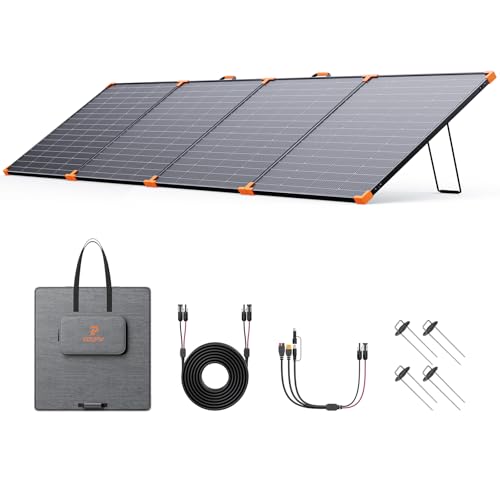
The ZOUPW lists 450W, Voc 45.9V and 29.5 lb, and includes a 13.12 ft 12AWG extension cable, a 4-in-1 connector cable, four ground stakes and a storage bag. It claims 25% efficiency, IP68 and a 36-month warranty.
The listing warns it is for 40 to 60V inputs and is not compatible with units under 30V such as the Jackery 1000, 500 and 300 or Bluetti EB70S. It names EcoFlow Delta series and Anker C1000 as compatible.
Key Specifications
- Rated power: 450W
- Weight: 29.5 lb
- Voc: 45.9V (listing)
- Extras: 13.12 ft 12AWG cable, 4-in-1 cable, stakes
- Warranty: 36 months
| Pros | Cons |
|---|---|
|
|
Things to Consider
The listing says it is not recommended for long-term fixed installation, series or parallel connections, or shaded operation.
Best For
Owners of 2kWh+ stations that accept 40 to 60V.
Skip It If
Skip it if your station takes under 30V.
Check the ZOUPW 450W Portable Solar Panel listing for the current specifications.
#3 NaveiTech 400W Portable Solar Panel: Best Mid-Weight Kickstand Panel
Why We Picked It
The NaveiTech lists 19.84 lb, folds to about 21 x 26 in, and has four adjustable kickstands. It claims 25% A+ monocrystalline cells, IP65 and hail-resistant ETFE, and says its parallel wiring means a single shadow will not cut the whole array.
The kit includes MC4 output cables plus an adapter bundle (XT60, DC5521, DC7909) and 10 DC5521 adapters. The listing notes that a station’s maximum input may be lower than 400W, so the station will never receive more than its limit.
Key Specifications
- Rated power: 400W
- Weight: 19.84 lb
- Folded size: about 21 x 26 in
- Cell: A+ monocrystalline, 25% claimed
- Rating: IP65 claimed
| Pros | Cons |
|---|---|
|
|
Things to Consider
The listing’s advice to check the station’s maximum input matches what we would say for any panel.
Best For
Buyers who want a kickstand panel with adapters included.
Skip It If
Skip it if you want a named warranty term in the excerpt.
See the NaveiTech 400W Portable Solar Panel listing for current details.
Other Options Worth Considering
The CTOLITY 400W lists 23.4% monocrystalline cells, IP65, adjustable kickstands and 40V MC4, XT60 and Anderson outputs, but its excerpt gives no weight. The ALLPOWERS SP037 lists 40.8 lb with five foldable panels and says its modules are polycrystalline at 22%, so it is the heaviest here and suits a fixed spot, such as an RV roof, more than carrying.
How to Choose
Voltage First
High-wattage panels often have 40V or more. A small station that accepts under 30V can be damaged or simply refuse the input, so read the manual.
Input Limit
A 400W panel on a 300W input limit just charges at 300W.
Weight
Weights run from 16 to over 40 lb. Plan how you will carry it.
Cable Gauge
A thicker cable such as 12AWG loses less power over distance.
Safety
Panels are live whenever light hits them, so handle connectors with care.
How We Evaluate
We compared each listing’s stated wattage, cell type, efficiency, weight, folded size, connectors, included cables, ports, waterproof rating, certifications and warranty. Efficiency, waterproof and lifespan figures are the sellers’ claims, and we have not measured these panels ourselves. Real output depends on sun angle, temperature, shade, cable length and your power station’s input limit. Keep panel connectors dry and fully seated, do not step on or place heavy objects on a panel, and never connect panels in series or parallel without confirming your power station’s voltage and current limits.
Frequently Asked Questions
Can I use a 400W panel on a 1000Wh station?
Only if its voltage and input limit allow it. Many 1000Wh stations accept less than 400W.
Why do some panels have 40V or more?
High-voltage panels suit larger stations that accept a wider voltage range.
Is a blanket panel better?
It folds smaller and weighs less, but needs stakes or weights in wind.
Do I need a longer cable?
A longer cable lets you keep the station in shade while the panel is in the sun.
Can I leave it out overnight?
Listings claim weather resistance, but check the manual and keep connectors dry.
Final Verdict
The Renogy blanket is our pick for weight, the ZOUPW is for high-voltage stations, and the NaveiTech is a mid-weight kickstand panel. Browse the full portable solar panels category.
About the author

The Home Power Up team researches and writes buying guides on portable power stations, solar, generators and home backup power. We compare manufacturer specifications, listing details and published ratings to help US homeowners choose gear. We do not test products ourselves, and we explain our method in How We Review.