
LiFePO4 vs AGM Deep Cycle Batteries: Which Should You Buy?
How LiFePO4 and AGM deep-cycle batteries compare on weight, usable capacity, cycle claims, charging and cold-weather behavior.
 By Home Power Up Team
Updated November 11, 2026
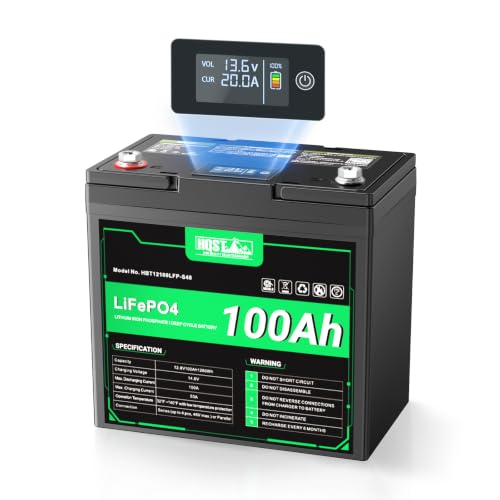
Both chemistries store energy for solar systems, RVs, boats and backup, but they behave differently in weight, usable capacity, charging and care. This guide compares LiFePO4 (lithium iron phosphate) and AGM (absorbent glass mat lead-acid) deep-cycle batteries so you can pick the right one.
Side by Side
| LiFePO4 | AGM lead-acid | |
|---|---|---|
| Weight (12V 100Ah) | About 22 lb in the listings we reviewed | About 60 to 64 lb in the listings we reviewed |
| Usable capacity | Makers often allow near-full discharge | Commonly advised to use about half |
| Cycle life | Makers claim thousands of cycles (claims vary widely) | Fewer cycles, depending on depth of discharge |
| Charging | Needs a LiFePO4-capable charger | Works with common lead-acid chargers |
| Cold charging | BMS often stops charging below freezing | Charges in the cold, more slowly |
| Maintenance | BMS manages protection | Sealed, but needs correct voltage and ventilation |
| Upfront cost | Typically higher; compare per usable kWh | Typically lower |
Usable Energy Example
A 12V 100Ah battery holds about 1,200 to 1,280Wh. If you use only half of an AGM battery for longevity, that is roughly 600Wh. A LiFePO4 battery of the same size may let you use most of its energy, so for the same nominal rating you often get more usable energy and a lighter battery. Always check the maker’s depth-of-discharge guidance.
Cycle Claims
Lithium listings state big cycle numbers, from about 4,000 to over 15,000. They are manufacturer claims, often measured at light discharge and under ideal conditions, and independent verification is rare. Lower claims from established makers are generally easier to credit. Compare claims on the same basis (percent of capacity remaining).
Which Should You Choose?
- Choose LiFePO4 if weight, usable capacity or frequent cycling matter, and you can use a compatible charger.
- Choose AGM if you want a familiar chemistry and charging with existing equipment, or if budget is tight and use is occasional.
- Check cold-weather behavior for your climate.
See our picks in best deep cycle batteries, and match chargers with battery chargers.
Frequently Asked Questions
Is LiFePO4 better than AGM?
Often for weight and usable energy, but it needs the right charger and costs more up front.
Can I mix AGM and LiFePO4 batteries?
No. Different chemistries should not be wired together.
Do LiFePO4 batteries work in the cold?
Many stop charging below freezing to protect cells. Check the stated limits.
Can I replace AGM with LiFePO4?
Often as a drop-in, if the charger and system voltage support it. Check the manual.
What about LiFePO4 in power stations?
See LiFePO4 vs lithium-ion power stations.
Summary
LiFePO4 is lighter and offers more usable energy; AGM is simpler to charge and familiar. Browse the deep cycle batteries category for options.
About the author

The Home Power Up team researches and writes buying guides on portable power stations, solar, generators and home backup power. We compare manufacturer specifications, listing details and published ratings to help US homeowners choose gear. We do not test products ourselves, and we explain our method in How We Review.